

About UsConsultation
Products


NewsContact usIndoor RAS System Equipment
Pumps
Indoor Farming Equipment
Outdoor farming Equipment






No items found.


Indoor RAS System Equipment
Pumps
Indoor Farming Equipment
Outdoor farming Equipment
11 September 2026
Choosing a commercial RAS system supplier is an engineering and operating decision, not only a price comparison. The supplier must understand the production goal, translate it into a water-treatment architecture, specify equipment that works together, support installation and help the farm operate the system after handover. Hatch Hives' own FAQ emphasises that aquaculture systems are not one-size-fits-all, which is a useful starting point for evaluating any supplier.
A credible proposal should ask about species, stocking conditions, target output, feed load, water source, site and operational goals before recommending equipment. If a quotation is based only on tank volume, it may ignore the biological and hydraulic load the system must manage. Ask the supplier to state the assumptions used in sizing and to identify which inputs still need confirmation.
The proposal should make it easy to understand what happens to water from the culture tanks until it returns. Mechanical solids removal, biological treatment, pumping, oxygen and gas management, disinfection where needed and monitoring should form a logical sequence. Hatch Hives' catalogue includes drum filters, biological filters, bio-media, protein skimmers, pumps, Compact RAS, RAS and CRAS, which allows buyers to discuss both individual modules and complete system architecture.
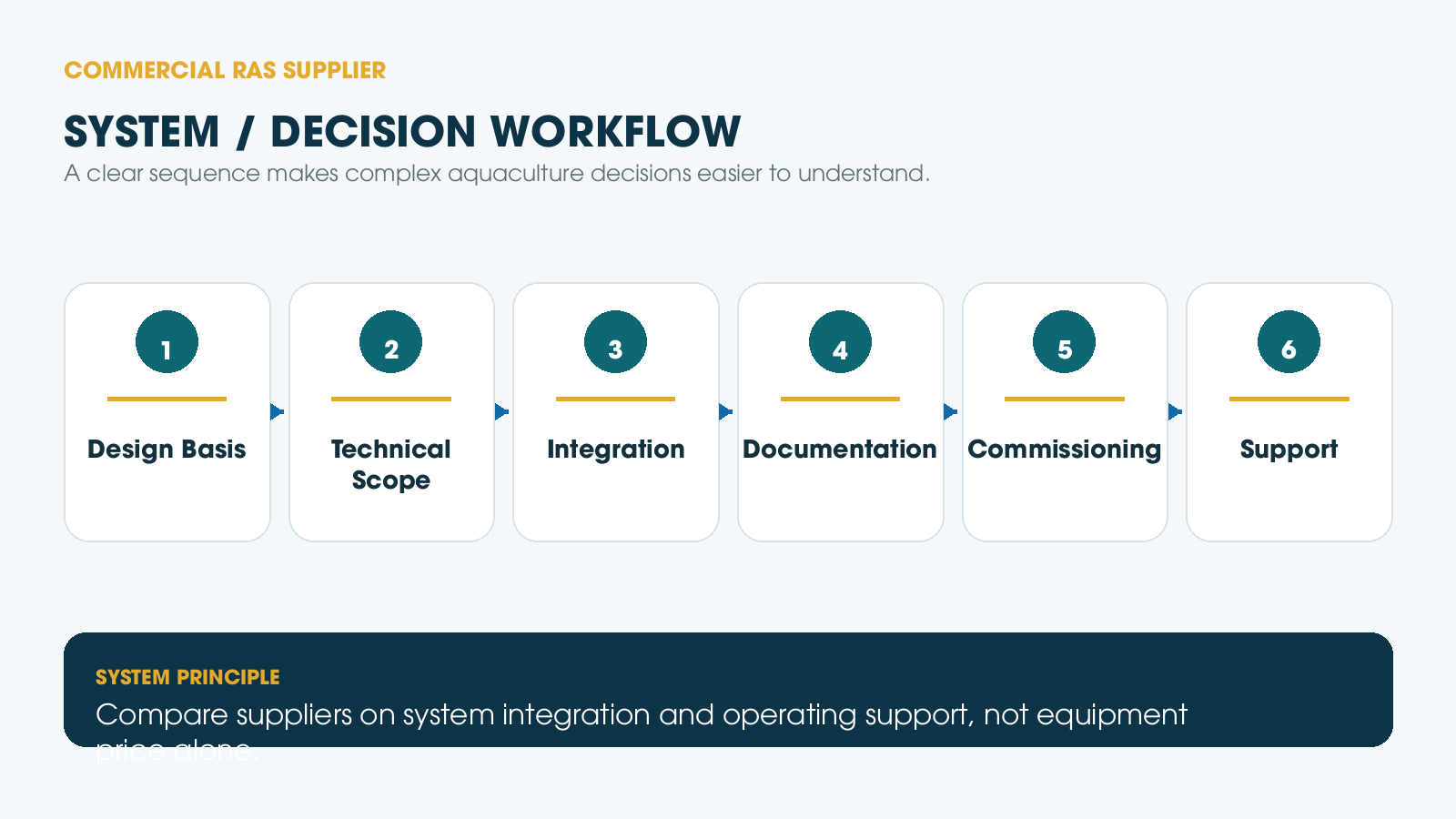
Equipment supply is only one part of a commercial project. Ask who is responsible for site readiness, piping, electrical work, control integration, startup and commissioning. Hatch Hives states that its engineers can support complete installation and setup. Whatever supplier you choose, the responsibility matrix should be clear before work begins.
A farm team needs enough information to operate and maintain the system. Useful documentation can include system flow diagrams, equipment manuals, maintenance requirements, control descriptions and troubleshooting guidance. Training should cover the daily operating routine and how individual treatment stages relate to water quality and production load.
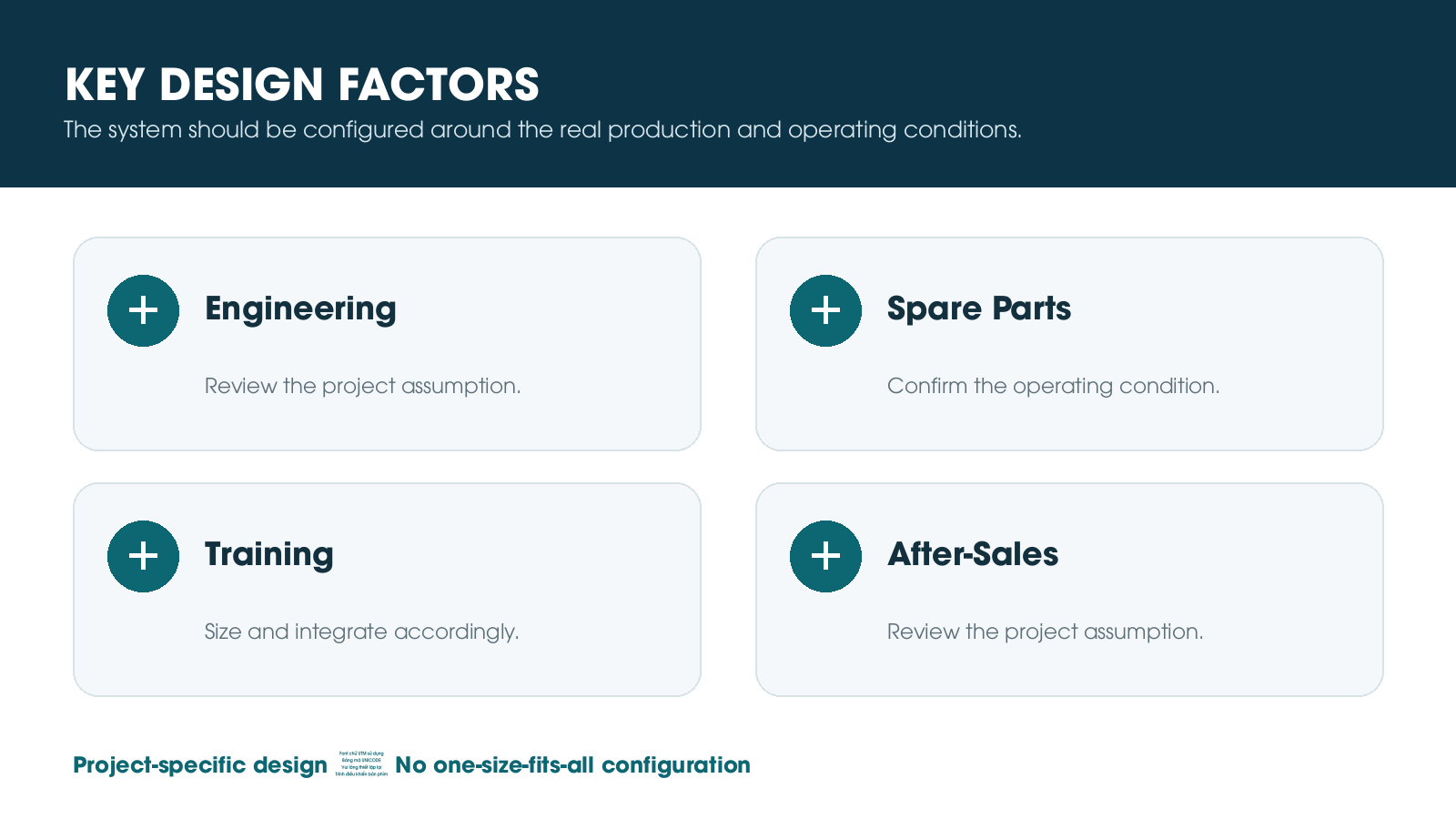
After-sales support affects the long-term usability of a technical system. Hatch Hives describes routine check-ins, upgrades, troubleshooting and technical assistance as part of its support approach. Its FAQ also states that technological components and equipment come with a comprehensive one-year warranty. Buyers should confirm the warranty terms, exclusions, spare-parts process and support channel for their own project.
Customisation is valuable only when it responds to a real project need. Hatch Hives says its Singapore design team and in-house engineering/manufacturing capability can develop customised technology and farm blueprints for different aquaculture species and regional conditions. A buyer should expect the same discipline from any supplier: changes should improve fit to the project, not create a collection of disconnected special features.
A useful supplier meeting should end with a list of open technical items rather than vague promises. Ask which inputs are confirmed, which remain assumptions, which equipment models are final, what site work is excluded and what acceptance checks will be completed during commissioning. Also confirm who the farm contacts if a problem appears after startup. Clear boundaries do not make a supplier look weaker; they make the project easier to manage because responsibilities and evidence are visible from the beginning.
For international projects, also confirm shipping, export documentation, remote support and the availability of local installation resources, because delivery logistics can affect the practical scope even when the equipment itself is suitable.
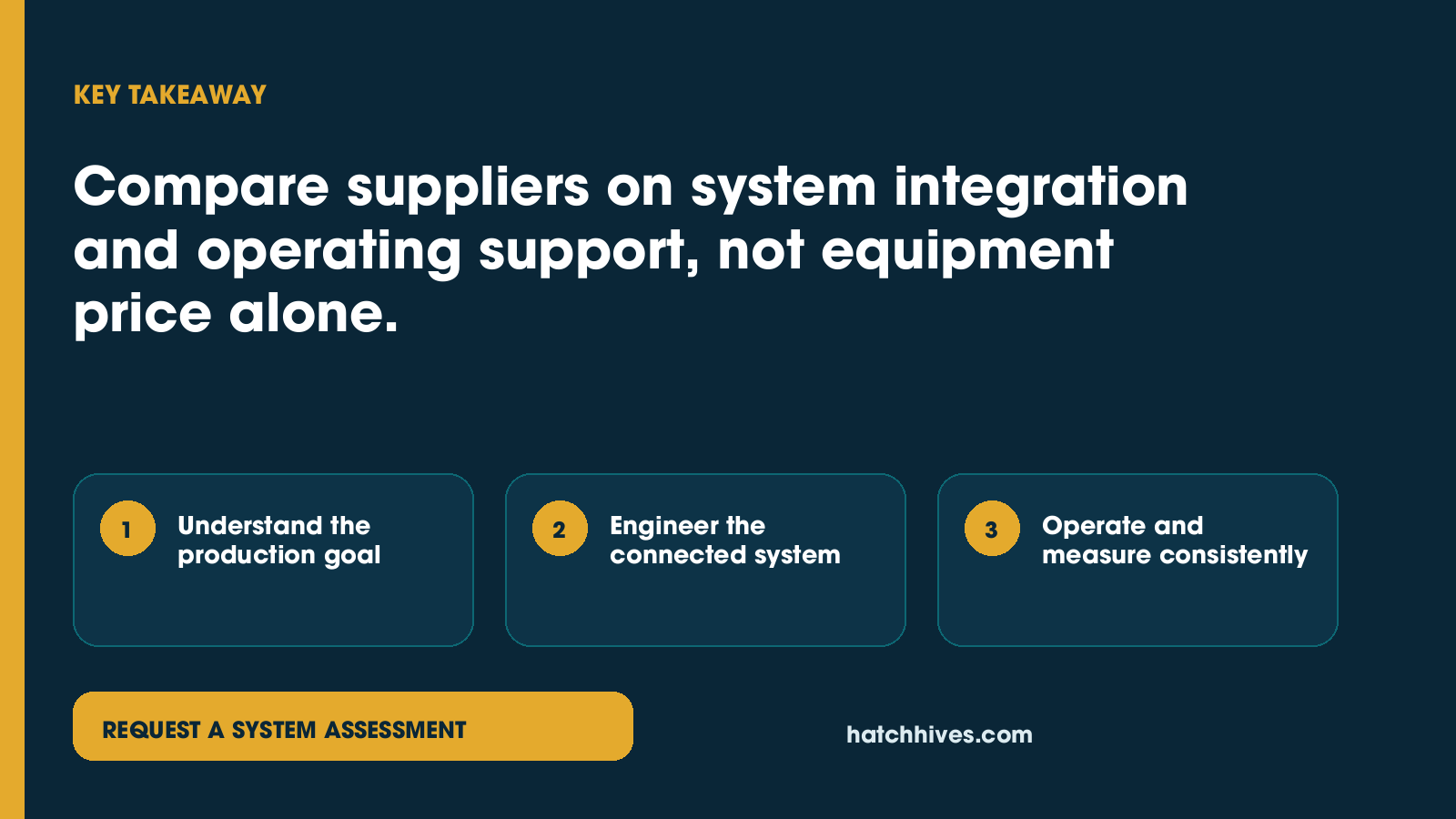
Next step: Use a Hatch Hives system assessment to build a project-specific supplier scope.