
About UsConsultation
Products


NewsContact usIndoor RAS System Equipment
Pumps
Indoor Farming Equipment
Outdoor farming Equipment





No items found.


Indoor RAS System Equipment
Pumps
Indoor Farming Equipment
Outdoor farming Equipment
Equipment
09 March 2026
In Recirculating Aquaculture Systems (RAS), water quality is not just an operational detail — it is the foundation of system performance, animal welfare, and sustainability.
Because RAS reuses up to 90–99% of its water, even small fluctuations in key parameters can quickly impact growth, feed efficiency, and biosecurity. Effective water quality management is what separates a stable RAS operation from a risky one.
In a RAS environment, water serves three essential roles:
When water quality declines, fish and crustaceans experience stress, reduced immunity, and poor performance. When water quality is stable, RAS delivers predictable, high-efficiency production.
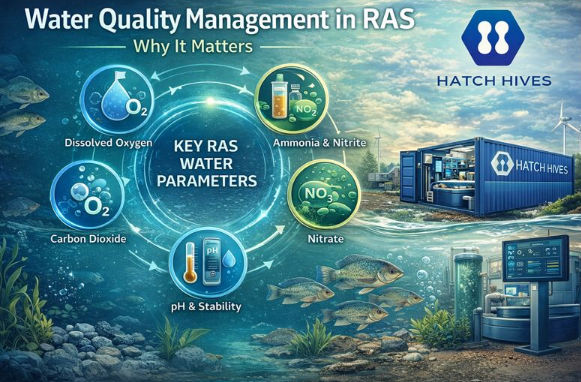
Oxygen drives metabolism, growth, and survival.
Low dissolved oxygen is one of the fastest ways to cause stress or losses in RAS. Continuous monitoring and reliable oxygen delivery systems are essential.
Ammonia is produced from waste and uneaten feed and is highly toxic. Nitrite interferes with oxygen transport in aquatic animals.
In RAS, efficient biofiltration is the primary defense against these compounds. A mature and well-managed biofilter is the heart of water quality control.
Nitrate is less toxic but accumulates over time in closed systems.
Managing nitrate through water exchange, denitrification, or circular integration is key to long-term system stability.
pH affects:
Gradual changes and proper buffering are far safer than rapid corrections.
Temperature directly influences metabolism, oxygen demand, feeding behavior, and immune response.
One of RAS’s greatest advantages is precise temperature control, allowing year-round production and optimized growth.
CO₂ accumulates from respiration and can limit oxygen uptake if not removed.
Degassing and aeration systems play a crucial role in maintaining balance.
Modern RAS relies on real-time monitoring and automation:
Automation reduces human error and allows early intervention before issues escalate.
✔ Design robust mechanical and biological filtration ✔ Avoid overfeeding and overstocking ✔ Monitor key parameters daily or continuously ✔ Maintain backup oxygen and power systems ✔ Train operators to respond quickly to deviations
Water quality management in RAS is not a one-time setup — it is a continuous operational discipline.
At Hatch Hives, water quality management is integrated into modular, climate-smart RAS designs. By combining smart monitoring, efficient filtration, and circular resource use, RAS becomes a scalable solution for sustainable aquaculture.
Water quality is the heartbeat of every Recirculating Aquaculture System.
When managed correctly, RAS delivers:
RAS isn’t magic — it’s science, managed with precision.