
About UsConsultation
Products


NewsContact usIndoor RAS System Equipment
Pumps
Indoor Farming Equipment
Outdoor farming Equipment





No items found.


Indoor RAS System Equipment
Pumps
Indoor Farming Equipment
Outdoor farming Equipment
Equipment
03 July 2026
When most people picture aquaculture, they see sprawling earthen ponds, aerators churning the water, and workers wading through mud to check on stock. That model has fed the world for decades — but it’s also bleeding money in ways most farmers don’t track closely.
Enter CRAS™ (Containerized Recirculating Aquaculture System) from Hatch Hives. At first glance, it looks like a simple shipping container. But inside, it’s a fully automated, water-recirculating farm that quietly eliminates five major cost centers traditional ponds can’t escape.
Here are the five cost savings you probably didn’t expect — backed by how CRAS™ works.
1. Water Costs: From Daily Drain to 90% Less Top-Up

Traditional ponds lose massive volumes of water daily through evaporation, seepage, and deliberate draining to manage waste. In many regions, you’re also paying for pumping, treatment, and discharge permits.
CRAS™ recirculates over 90% of its water. Only 5–10% needs topping up daily to account for evaporation and solid waste removal. That means:·
1) Lower monthly water bills
2) Reduced pumping energy
3) Fewer discharge compliance costs
The surprise: Many farmers don’t realize how much water they’re paying to throw away. CRAS™ turns that expense into a one-time setup cost.
2. Labor Costs: Automation Replaces Wandering
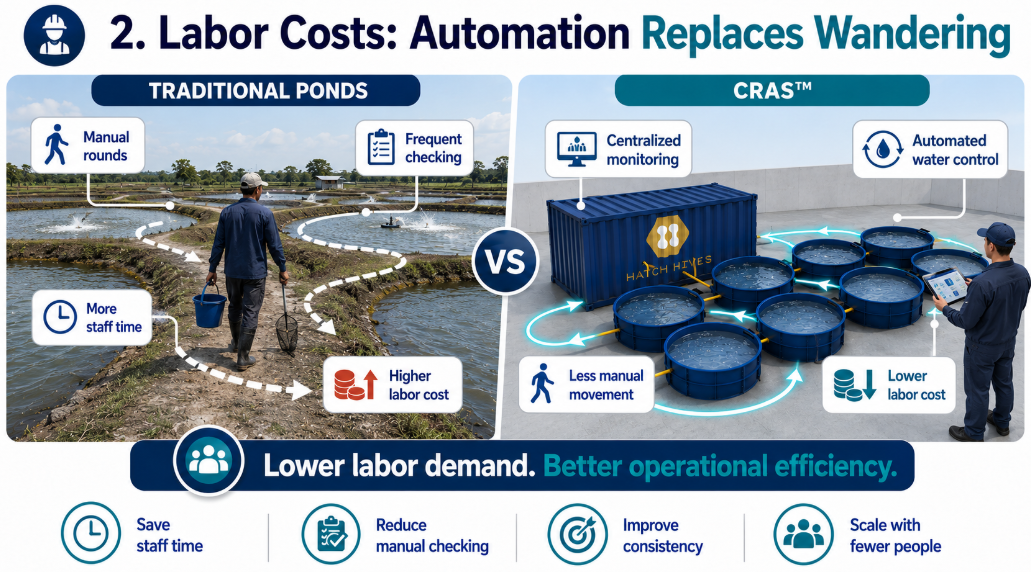
Traditional ponds are labor-intensive. Workers must walk pond banks daily, visually check stock, manually feed, test water with handheld kits, and chase leaks or predator damage. Multiply that across 10 ponds, and you need a full-time crew.
CRAS™ automates almost everything:
1) Centralized sensors monitor dissolved oxygen, pH, and temperature
2) Automatic feeders dispense precise amounts
3) Drum filters and protein skimmers clean water without human touch
One person can monitor multiple CRAS™ units from a phone or tablet.
The surprise: Labor isn’t just wages — it’s housing, transport, insurance, and turnover training. CRAS™ slashes all of it.
3. Land Costs: Vertical Farming, Not Horizontal Sprawl
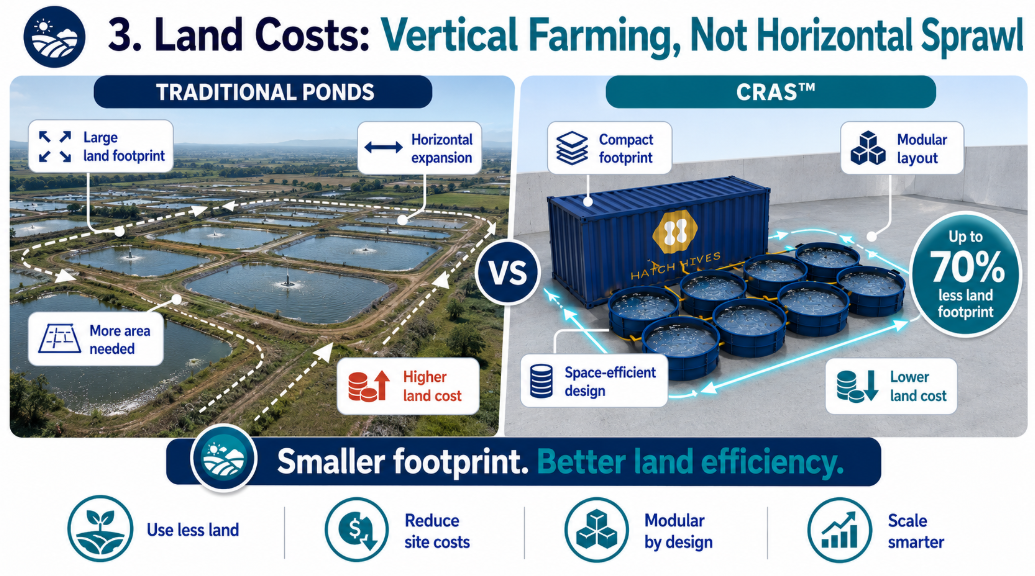
Traditional ponds are land-hungry. A single acre of pond might produce a few thousand kilograms of crawfish or tilapia per cycle. You also need buffer zones, access roads, and settlement ponds for wastewater.
CRAS™ stacks production vertically. One 40-foot container (about 320 sq. ft. of footprint) can match or exceed the annual output of a 0.5–1 acre pond — depending on species and density. You can place multiple containers on non-arable land (concrete, gravel, even rooftops).
The surprise: Land isn’t just purchase price. It’s property tax, maintenance, and opportunity cost. CRAS™ frees up your land for other uses — or lets you farm where land is too expensive to buy.
4. Medication & Treatment Costs: Clean Water = Healthy Stock

Traditional ponds are open systems. Birds drop pathogens. Rain brings runoff. Algae blooms crash oxygen levels. Bottom sludge breeds bacteria. To keep stock alive, farmers routinely use antibiotics, antifungals, and algaecides — all recurring costs.
CRAS™ is a closed, biosecure environment:
1) Ozone and UV sterilizers kill over 99% of pathogens
2) No contact with wild birds, soil, or runoff
3) Stable water quality means less stress, fewer diseases
Most CRAS™ operators report drastically lower — often zero — medication use after cycle one.
The surprise: Medication costs are obvious. The hidden saving is not losing an entire pond to disease — a catastrophic expense traditional farmers dread.
5. Mortality Costs: Survival Rates Go from 60% to 90%+
Traditional ponds are unpredictable. A sudden temperature swing, an unnoticed oxygen crash overnight, or a toxic algae bloom can kill 30–40% of a crop. Crawfish and shrimp are especially sensitive in their early life stages.
CRAS™ maintains ideal conditions 24/7:

1) Nanobubble generators keep dissolved oxygen consistently high
2) Temperature is controlled, not weather-dependent
3) Ammonia and nitrites are filtered out continuously
Operators routinely see survival rates of 85–95% from fry to harvest — compared to 50–70% in many traditional pond systems.
The surprise: Mortality isn’t just lost product. It’s wasted feed, wasted labor, and lost time. In CRAS™, you harvest more of what you feed.
The Bottom Line
Traditional ponds aren’t going away overnight. But for farmers looking to scale, reduce risk, or farm on expensive or limited land, CRAS™ offers a clear financial case.
Add up water, labor, land, medication, and mortality — then compare. Many CRAS™ users report full system payback in 18 months or less.
Want to run the numbers for your farm? Contact Hatch Hives for a customized ROI projection based on your target species and local costs.
Hatch Hives is the technology and manufacturing division of Singapore Crawfish (SGCF), providing CRAS™, Mini-RAS, and nanobubble systems for sustainable aquaculture worldwide.