
About UsConsultation
Products


NewsContact usIndoor RAS System Equipment
Pumps
Indoor Farming Equipment
Outdoor farming Equipment





No items found.


Indoor RAS System Equipment
Pumps
Indoor Farming Equipment
Outdoor farming Equipment
Equipment
03 July 2026
The global seafood industry is at a crossroads. Wild fisheries have reached their limits, and traditional aquaculture methods—while essential—are increasingly challenged by water scarcity, environmental regulations, and climate unpredictability. The numbers tell a clear story: aquaculture now supplies over 50% of the world's seafood, and demand is only growing.
Enter Recirculating Aquaculture Systems (RAS). This isn't just a niche technology—it's a fundamental shift in how we produce protein. And for forward-thinking farmers, investors, and entrepreneurs, it represents the most significant opportunity in aquaculture today.
Traditional fish farming relies on open ponds or flow-through systems where water is used once and discharged. In contrast, RAS continuously filters, cleans, and reuses water in a closed loop. The difference is dramatic: advanced RAS systems recycle 95–99% of their water, compared to 0% in conventional flow-through systems.
But water conservation is just the beginning.
Open systems are vulnerable. Disease outbreaks from wild populations, sea lice infestations, and pollution events can devastate production. In RAS, fish are raised in a fully controlled, indoor environment. This means:
The results speak for themselves: RAS operations report up to 50% lower mortality rates compared to traditional methods.
When fish aren't stressed by fluctuating water quality, disease threats, or poor conditions, they thrive. Controlled environments allow for precise temperature, oxygen, and feeding optimization. Studies show RAS-reared fish experience:
Traditional aquaculture is a major contributor to water pollution—approximately 79% of feed nitrogen and 83% of feed phosphorus in conventional systems are lost to the surrounding environment, causing eutrophication and ecosystem damage. RAS captures and treats waste on-site, substantially reducing environmental discharge.
By using renewable energy integration, RAS can achieve a carbon footprint lower than nearshore farming. This positions RAS operations favourably for sustainability certifications and ESG-conscious investors.
Perhaps most transformative: RAS can be located almost anywhere. Farms can be established close to major consumer markets, reducing transport costs, food miles, and carbon emissions while delivering fresher product. Urban areas, arid regions, and countries with limited land can now develop local aquaculture industries.
This isn't theoretical. The global RAS market was valued at USD 3.4 billion in 2024 and is projected to reach USD 8.2 billion by 2034, growing at a robust 9.4% CAGR. Commercial fish farms already account for over 71% of RAS adoption, and modular, containerized systems represent the fastest-growing segment.
Why the rapid growth? Because RAS delivers what investors and operators demand:
At Hatch Hives, we've taken RAS technology further. Our CRAS™ (Containerized Recirculating Aquaculture System) is a fully integrated, plug-and-play solution that delivers all the benefits of advanced RAS in a transportable, modular format.
What's included in every CRAS™ system:
The advantages are clear:
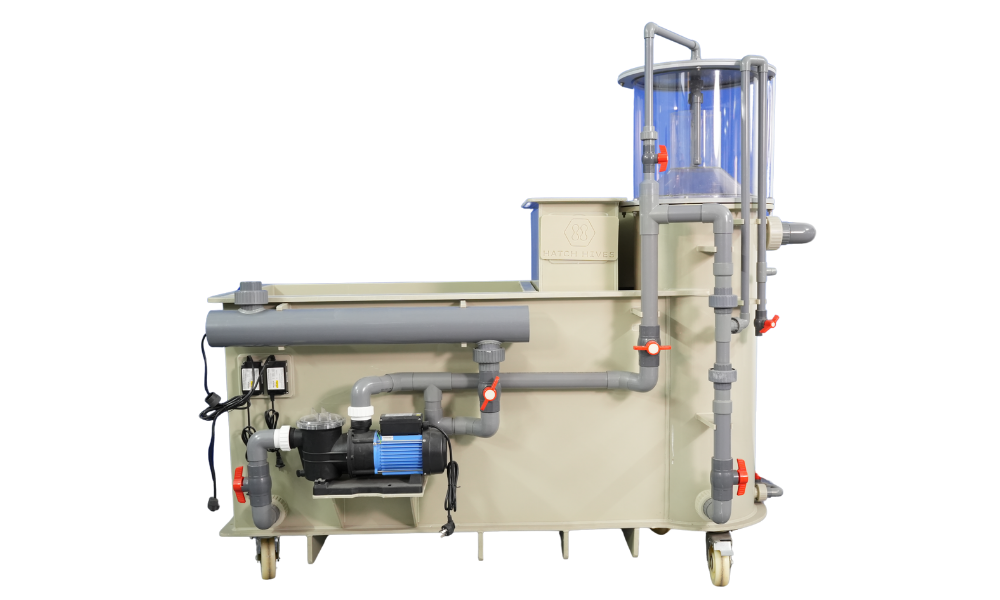
For smaller operations or R&D facilities, our Mini-RAS delivers the same high-level performance in a compact, space-efficient design.
Our systems are already deployed globally, with pilot hatcheries operating in Malaysia, Cambodia, Indonesia, and Bhutan. Operators report:
Climate change, water scarcity, and environmental regulations aren't going away. The question isn't whether aquaculture will modernize—it's who will lead the transformation.
Hatch Hives offers the technology, expertise, and turnkey solutions to position your operation at the forefront of sustainable aquaculture. Whether you're a commercial producer looking to scale, an investor entering the sector, or a government supporting food security initiatives, we have a system that fits your needs.
Ready to build the future of fish farming?
👉 Visit www.hatchhives.com today to explore our CRAS™ and Mini-RAS systems, request a custom quote, or speak with our aquaculture specialists.
Hatch Hives is the technology and manufacturing division of Singapore Crawfish (SGCF), delivering advanced RAS solutions for sustainable aquaculture worldwide.