
About UsConsultation
Products


NewsContact usIndoor RAS System Equipment
Pumps
Indoor Farming Equipment
Outdoor farming Equipment





No items found.


Indoor RAS System Equipment
Pumps
Indoor Farming Equipment
Outdoor farming Equipment
Equipment
12 September 2026
For many farms, the largest uncertainty in upgrading to controlled aquaculture is not the existence of the technology. It is how the system will behave under the farm's real conditions and how the team will operate it every day. A pilot can create evidence before a larger investment. Hatch Hives' RAS and CRAS portfolio provides different architectural routes, and a compact or modular phase can be used to test assumptions when the commercial design is not yet fully proven.
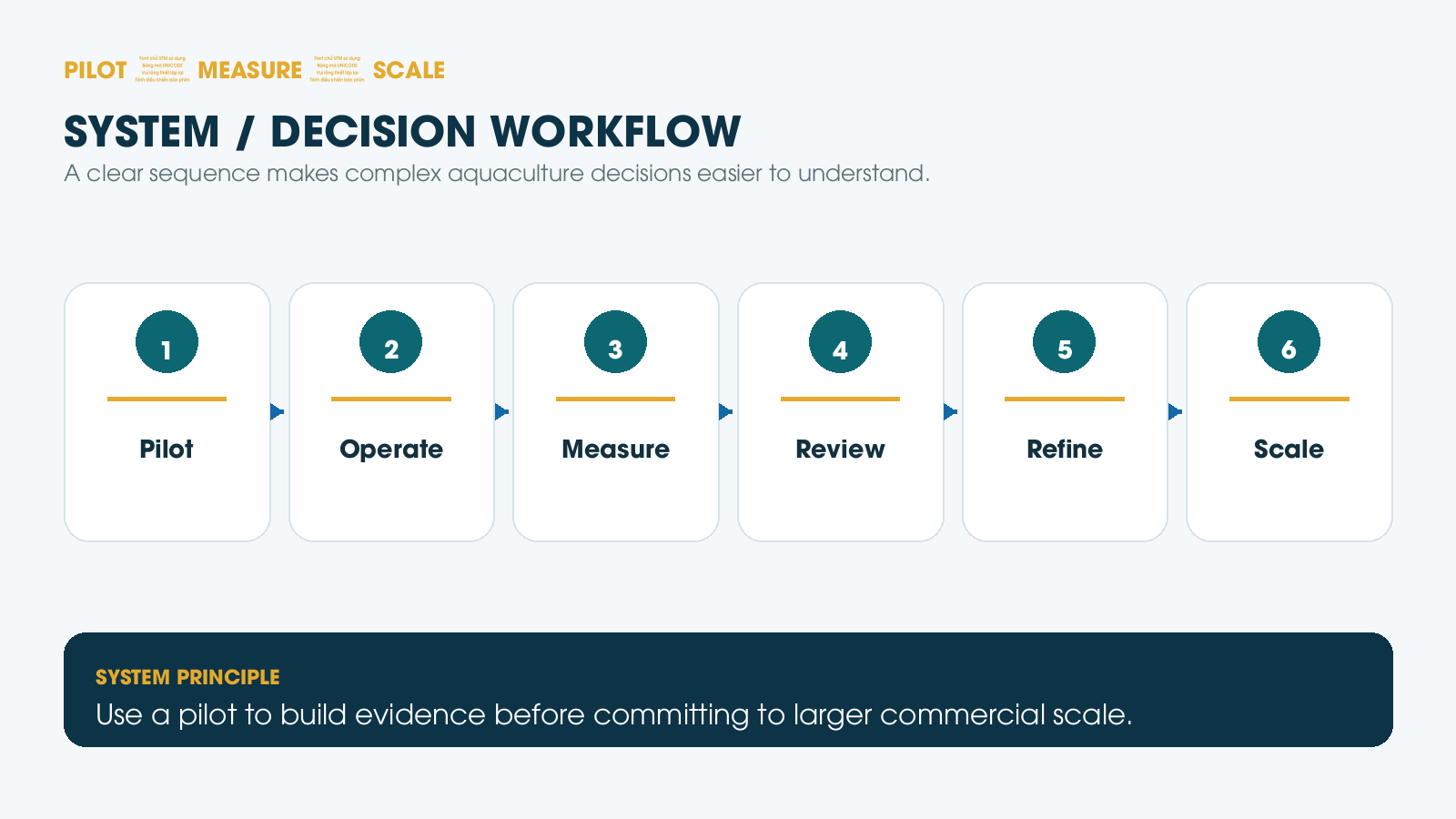
A pilot should reveal what the team actually has to do each day. Record feeding, water checks, solids removal, filter cleaning, stock observation, grading or handling, sensor checks and any manual adjustments. If a process is difficult or frequently missed at pilot scale, it may become a larger problem after expansion. The pilot is a chance to simplify the operating routine before more tanks or treatment capacity are added.
Track the water-quality parameters defined for the species and observe how the treatment line responds to changes in biomass and feed. Mechanical filtration should export solids consistently. Biological treatment should be monitored as production load develops. Pumping, oxygen or aeration, temperature control and other conditioning functions should be reviewed as part of the same system.
Technology can reduce some manual tasks, but it also introduces technical routines. Record how much time the team spends inspecting filters, cleaning, checking pumps, responding to alarms and maintaining sensors. Note which spare parts, tools and technical skills are required. These measurements help estimate how the operating organisation needs to grow with the farm.
The pilot should collect production records appropriate to the species and life stage: survival, growth, feed, health observations, grading results and any husbandry events the farm normally tracks. These records should be reviewed together with water and operating data. The goal is not to prove a universal performance number; it is to understand how the stock responds in this system under this farm's conditions.
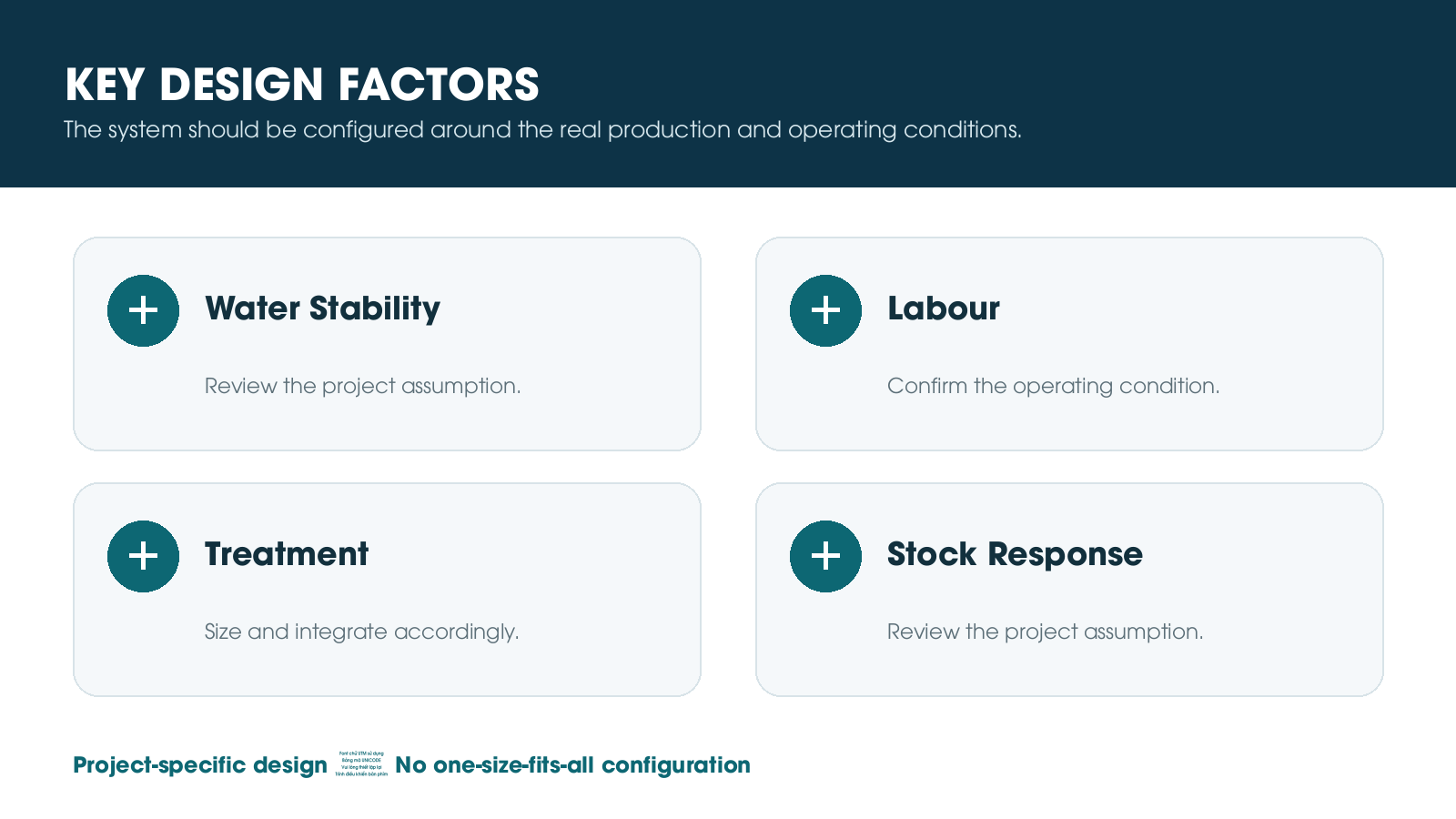
Power use, water replacement, oxygen or air demand, heating or cooling, waste handling and backup requirements can become important commercial inputs. A pilot helps identify where the site or system is close to a constraint. It can also show whether the planned monitoring and control approach gives operators enough information.
Once the pilot has run through representative operating conditions, the farm can review which assumptions were correct, which processes need improvement and what treatment capacity the next phase should support. The commercial design can then use measured feed load, flow, maintenance and operator data rather than relying only on generic expectations. Pilot first, measure the system, then scale the parts that are ready.
Before scaling, hold a pilot review that separates observations from decisions. First list what the team actually measured. Then identify what those measurements suggest about equipment, labour, utilities and production. Finally, decide which changes are required before the next phase. Keeping these steps separate reduces the risk of scaling based on a single good week or one isolated problem. The value of the pilot comes from repeated operating evidence and from turning that evidence into better design assumptions.
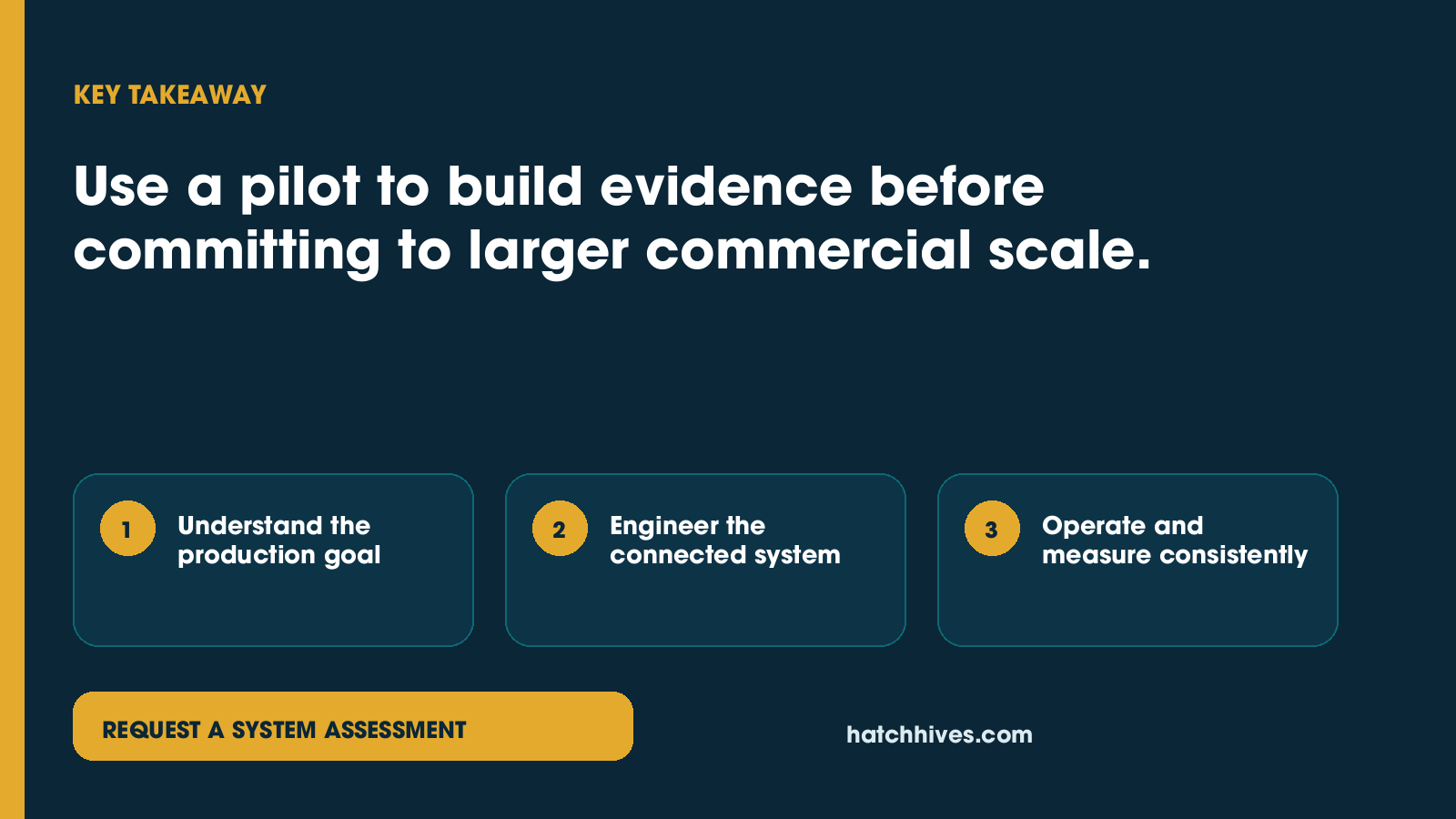
Next step: Discuss a pilot-to-commercial pathway with Hatch Hives.
Use a pilot RAS or controlled aquaculture system to measure water stability, treatment behaviour, labour, maintenance, stock response and utilities before scaling.