
About UsConsultation
Products


NewsContact usIndoor RAS System Equipment
Pumps
Indoor Farming Equipment
Outdoor farming Equipment






No items found.


Indoor RAS System Equipment
Pumps
Indoor Farming Equipment
Outdoor farming Equipment
Equipment
11 September 2026
A good aquaculture farm design begins before equipment is purchased. Hatch Hives' consultation service includes custom farm and hatchery design, installation and set-up, maintenance and on-site support. That scope reflects the real project sequence: first define what the farm needs to produce, then review the site and utilities, then design the water-management system, and only after that finalise equipment, installation and operating procedures.
The first stage is to define the species, production stage and target output. A hatchery may prioritise different tank sizes and control requirements from a grow-out farm. The team should identify target biomass and feed assumptions, water source, temperature and salinity, desired level of control and any regulatory or site constraints that are already known. These inputs create the design basis for the next stage.
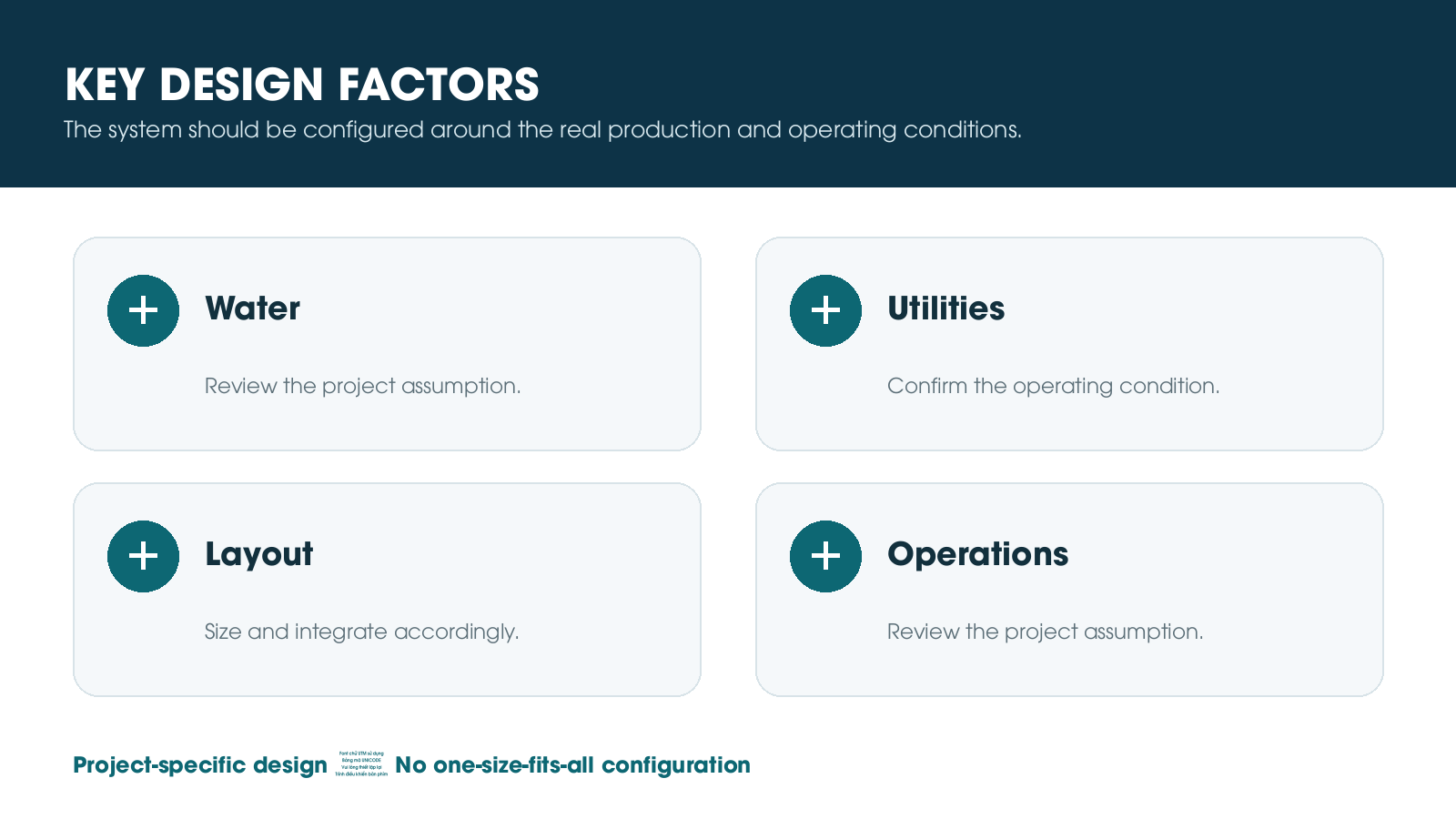
A technical site review looks at available area, building dimensions, drainage, water supply, power, access, equipment delivery routes and maintenance space. For an existing farm, it should also document the current tanks, pumps, filtration and pipework. The goal is to understand what can be retained, what must be changed and how the new treatment line can be integrated without creating operational bottlenecks.
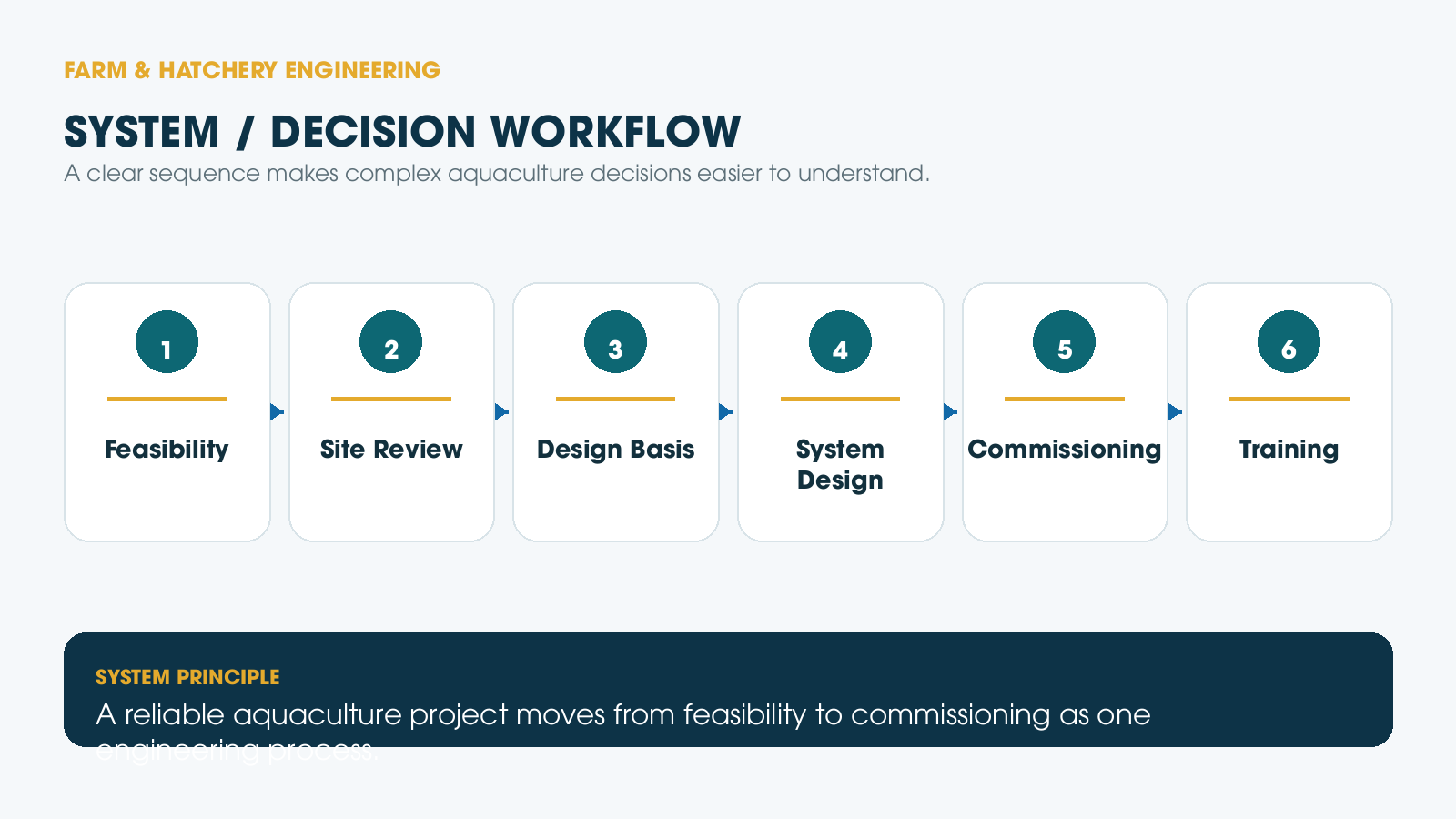
The system layout should show the culture area and the complete water path. Mechanical solids removal, biological treatment, pumps, gas and oxygen management, disinfection where required, monitoring and return flow all need to be placed in an order that operators can understand and service. Hatch Hives offers Compact RAS, customised RAS and CRAS architectures, so the layout can be developed around both the production needs and the available footprint.
Once the design and equipment scope are confirmed, installation connects the engineering plan to the physical farm. Pipe routes, valves, pumps, electrical connections, controls, drainage and maintenance access must match the drawings and the intended operating logic. Hatch Hives states that its engineers can provide on-site installation and setup support rather than only supplying equipment.
Commissioning verifies that water follows the intended path and that pumps, filters, sensors, controls and alarms are operating as planned. It is also the right time to confirm cleaning routines, basic maintenance and the responsibilities of the farm team. Training should help operators understand not only what button to press, but what each treatment stage is doing and what changes in water or equipment behaviour may mean.
A technically impressive system can still be difficult to run if access, cleaning, monitoring and operator workflow were not considered during design. The best farm layouts therefore treat operations and maintenance as engineering inputs from the beginning. That is particularly important for farms moving from traditional methods into more controlled RAS or CRAS production.
Before construction starts, run an operator walk-through using the latest layout. Imagine a normal day: where staff feed, where they inspect water, how they reach the drum filter, where waste leaves the system, how a pump can be isolated, and how an alarm is investigated. This simple review often identifies practical issues that are difficult to see on a technical drawing alone. Correcting access and workflow during design is usually much easier than changing them after equipment is installed.
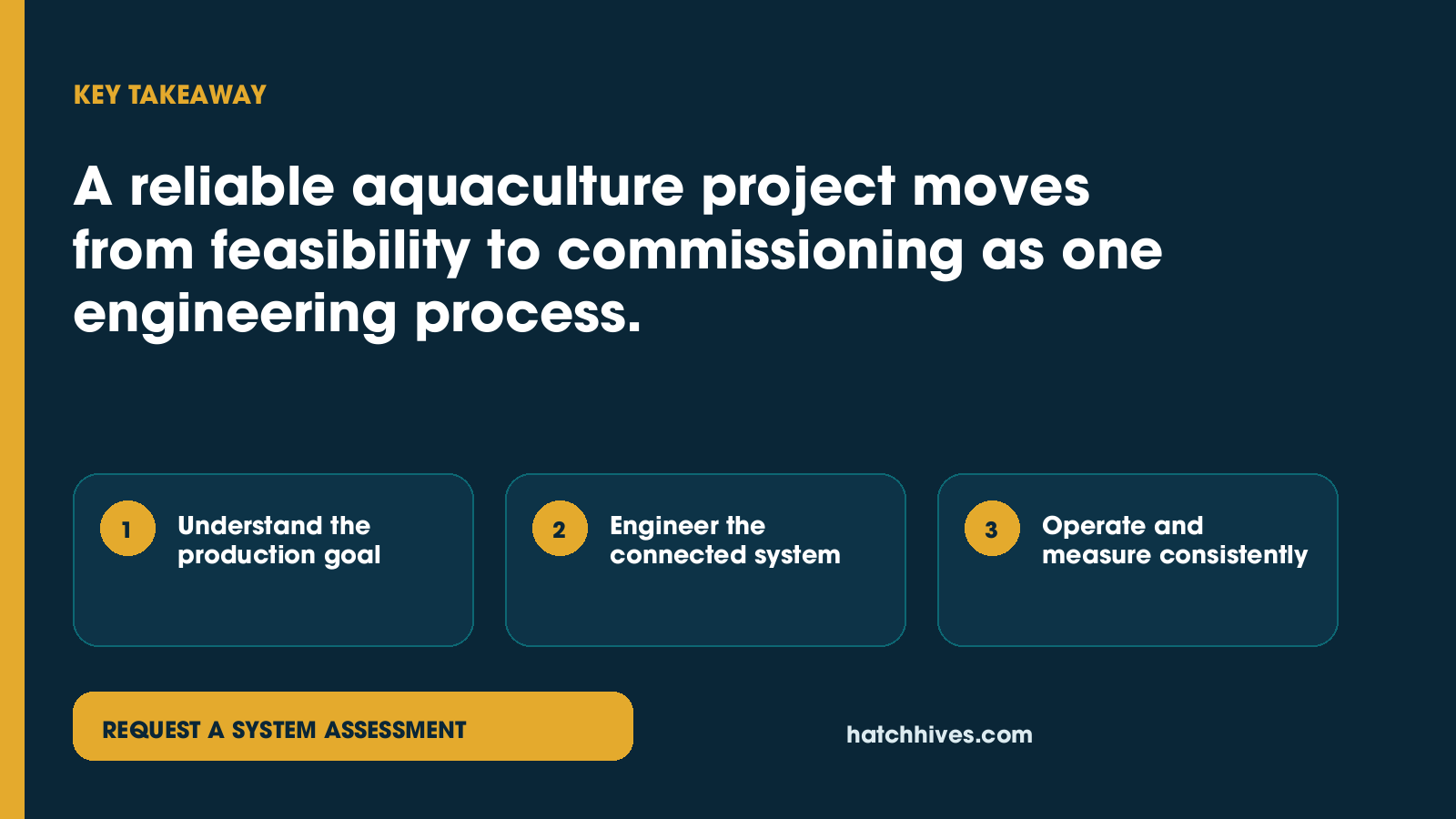
Next step: Book a preliminary farm or hatchery design discussion with Hatch Hives.