
About UsConsultation
Products


NewsContact usIndoor RAS System Equipment
Pumps
Indoor Farming Equipment
Outdoor farming Equipment






No items found.


Indoor RAS System Equipment
Pumps
Indoor Farming Equipment
Outdoor farming Equipment
Equipment
03 September 2026
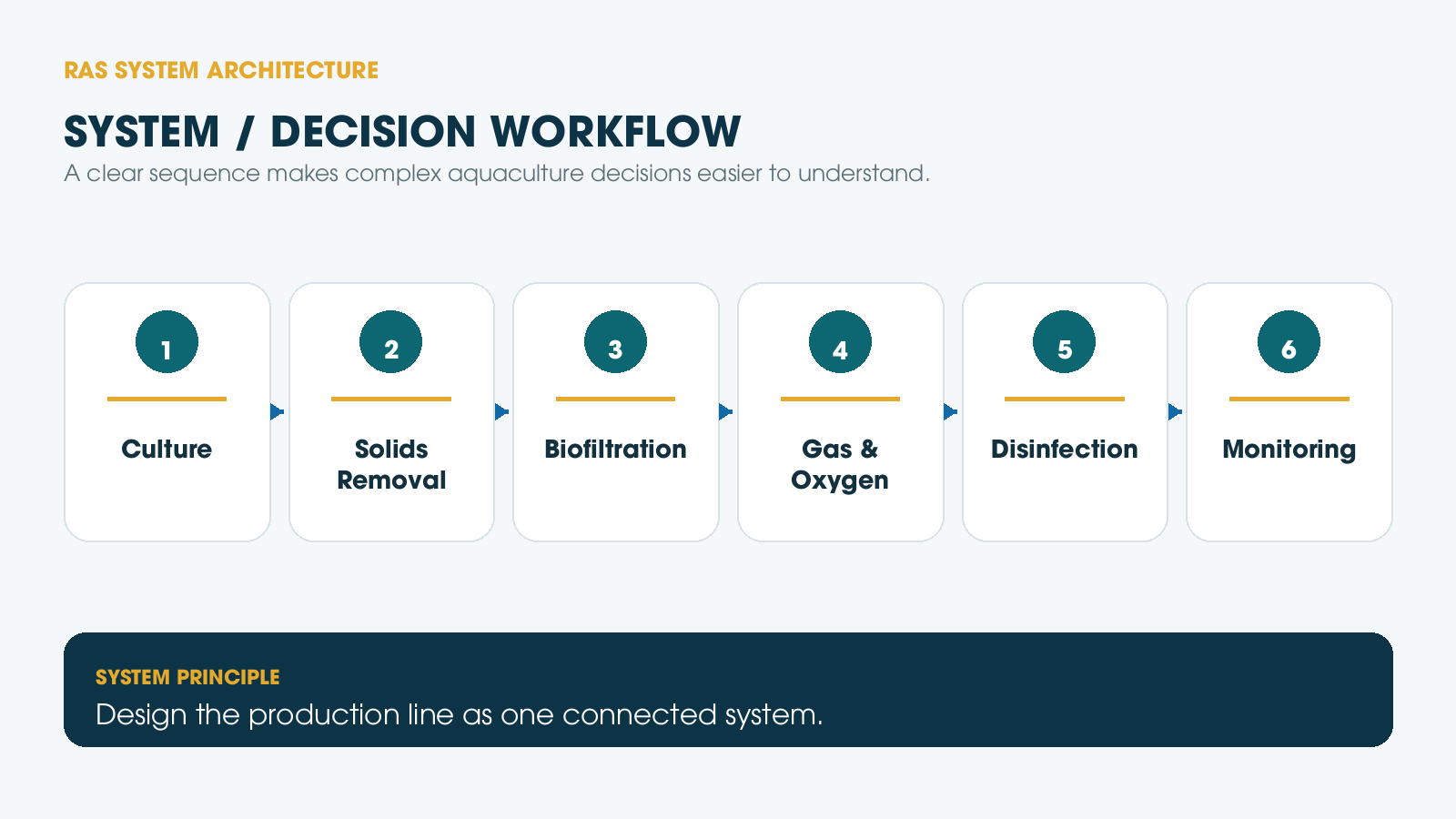
A modern aquaculture farm is easy to misunderstand when it is viewed as a collection of separate machines. Tanks hold the stock. Pumps move water. Filters remove waste. Sensors display readings. But in a Recirculating Aquaculture System (RAS), these parts only create value when they operate as one connected production line. Water leaving the culture area carries the biological load created by stock and feed. The treatment line must remove solids, manage dissolved waste, support oxygen conditions, control unwanted microorganisms where required, and return water to production in a condition the farm can manage consistently.
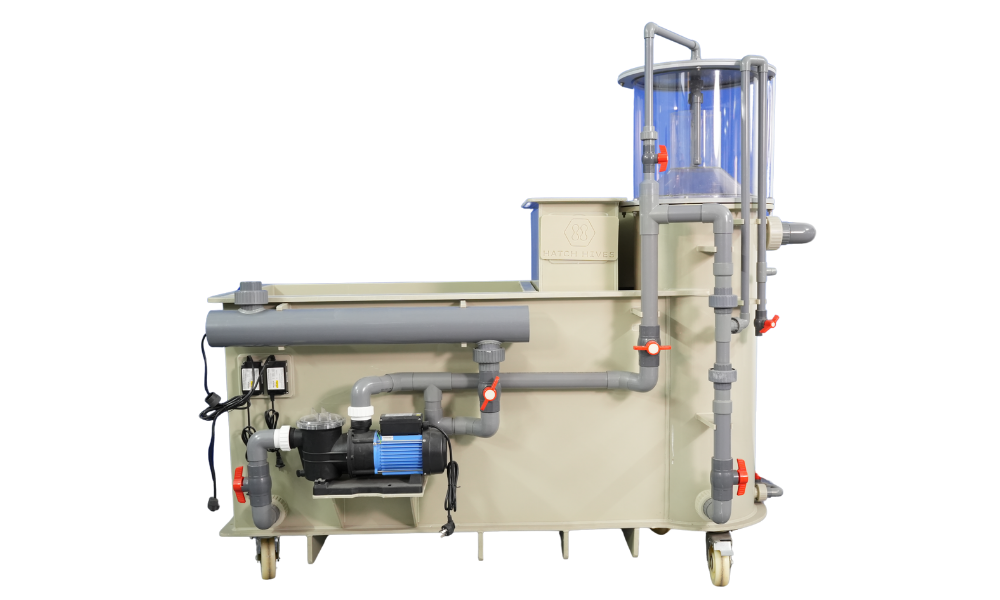
Hatch Hives presents RAS as a controlled water-management system rather than a single filter or tank. This distinction matters because every treatment stage changes the load that reaches the next stage. If solids are not removed effectively, downstream biological treatment has to deal with more organic matter. If pumps and pipework do not match the required flow, even correctly selected treatment equipment may not receive the water it was designed to handle. Monitoring is also part of the system because operators need information to understand whether the water loop is behaving as expected.
A practical RAS begins at the culture tank, where feeding and animal metabolism create solids and dissolved waste. Water is then moved to mechanical treatment, commonly including equipment such as a rotary drum filter. Mechanical filtration captures suspended solids before they continue through the system. Biological treatment provides surfaces and conditions for beneficial microorganisms to process nitrogenous waste. Depending on the project, the line may also include protein skimming, gas management, oxygenation, UV or other disinfection methods, heating or cooling, and water-quality monitoring. Treated water is then returned to the culture tanks and the cycle continues.
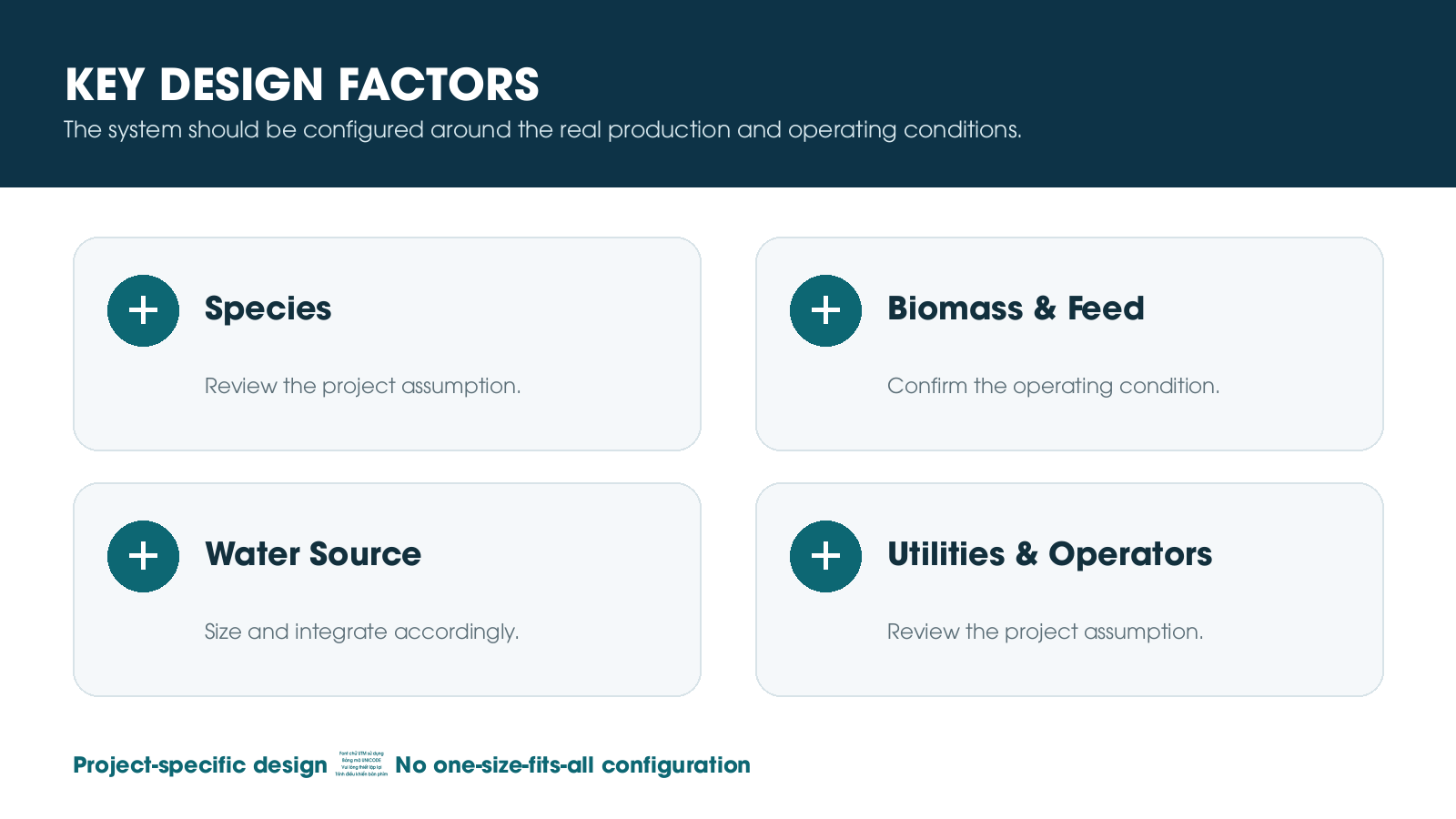
Two farms can hold a similar volume of water and still require different system configurations. Species, life stage, target biomass, feed input, water source, temperature, oxygen demand, operating routine and site conditions all influence the treatment load. This is why Hatch Hives states in its FAQ that there is no one-size-fits-all RAS or CRAS solution. A system assessment should begin with the farm's production objective and operating conditions, not with a catalogue item chosen in isolation.
The engineering task is not finished when equipment arrives on site. The water path, pipe sizing, pumps, access for cleaning, controls, alarms and maintenance routine all affect how usable the system is every day. Hatch Hives' consultation scope includes farm and hatchery design, installation and setup, maintenance, troubleshooting and on-site support. That service structure reflects an important principle: the farm team must be able to operate the system, understand its condition and respond when performance changes.
For a new farm or an upgrade, a better first question is not “Which filter should I buy?” but “What production load must the entire system support?” Once species, output target, site, utilities and operating goals are clear, the treatment architecture can be reviewed as one connected line. That is the foundation for selecting between a compact RAS, a customised RAS, a containerised CRAS or an equipment upgrade.
Before finalising a production-line design, collect a simple operating brief: species, maximum expected biomass, daily feed assumptions, source water, available power, space, maintenance access and the experience level of the team. Then review the complete water path on one drawing. If an equipment item cannot be linked clearly to a treatment role or operating need, question why it is there. This exercise keeps the project focused on production and makes later conversations about equipment, controls, commissioning and support much more concrete.
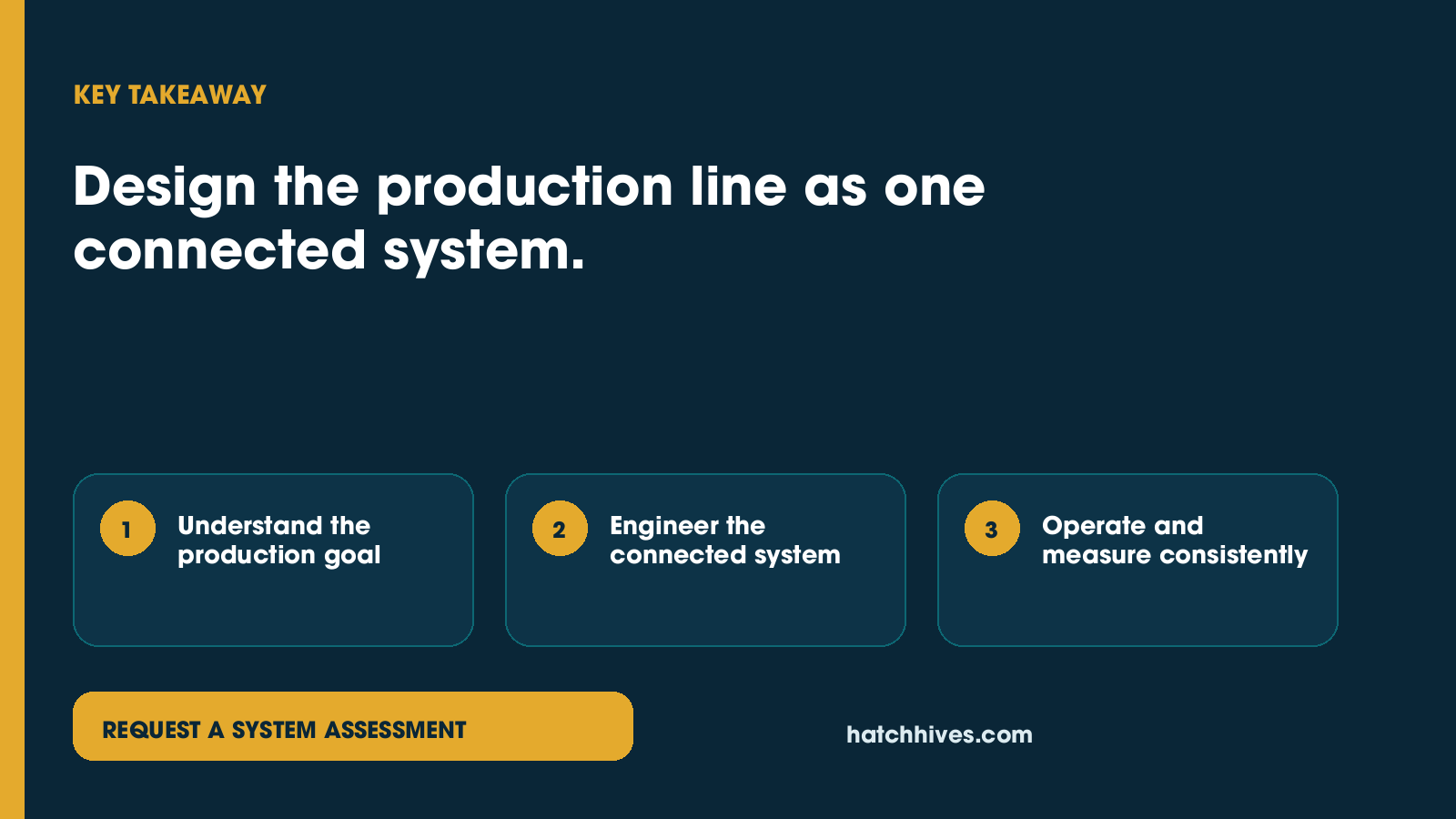
Next step: Request a Hatch Hives system assessment.